

Pharmacogenetic Testing
Pharmacogenetics
Personalised Medicine
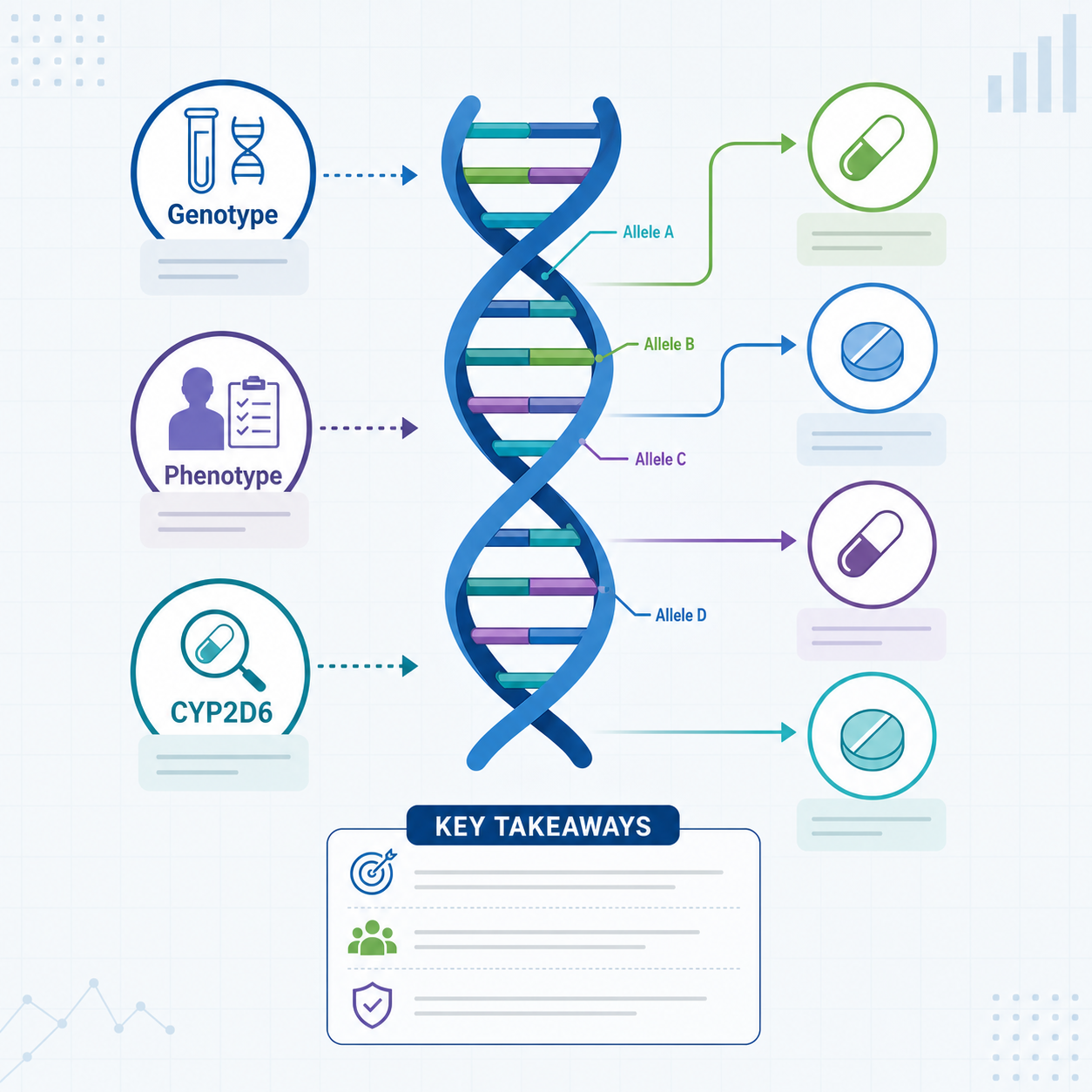

A pharmacogenetic DNA test result usually contains two levels of information: a genotype, which describes the genetic variants identified, and a predicted phenotype, which estimates how those variants may influence the activity of a drug-metabolising pathway.
For CYP2D6, the interpretation also depends on the test’s variant coverage, copy-number analysis, the translation standard used by the laboratory and the medicine being considered. The most clinically relevant interpretation connects the DNA result to current guidance for a specific gene–drug pair.
A pharmacogenetic result can support a more informed prescribing discussion. It does not diagnose disease, guarantee treatment response or replace a doctor, pharmacist or other qualified healthcare professional.
A clinically robust interpretation usually moves through five questions:
The report should therefore be read as a starting point for medicine-specific clinical interpretation, rather than as a standalone instruction.
A pharmacogenetic DNA test analyses selected genetic variants that may influence response to particular medicines. Depending on the test, the analysis may include genes coding for drug-metabolising enzymes, transport proteins, receptors and human leukocyte antigen, or HLA, systems.
The result is not a diagnosis of disease. It is genetic information that may help identify a potential gene–drug interaction affecting medicine exposure, efficacy or tolerability.
BioAgeDiagnostics describes its DNA Health and iGenius services as translating complex genetic data into clinically relevant information, including pharmacogenomics and medicine-sensitivity profiling. The information is intended to support medication selection and dosing considerations alongside clinical judgement. BioAgeDiagnostics: Genetic insights | BioAgeDiagnostics: iGenius for clinical practice
The usefulness of any pharmacogenetic report depends on the genes and variants tested, the laboratory method, the interpretation framework and the evidence available for the medicine under consideration.
A genotype is the combination of genetic variants identified in a particular gene. For many pharmacogenes, one allele is inherited from each biological parent. The pair is often reported as a diplotype.
For example, CYP2D6*1/*4 identifies two CYP2D6 alleles. The notation describes the genetic finding, but it does not provide a complete prescribing recommendation by itself.
A clinically meaningful interpretation also requires information about:
The CPIC and DPWG consensus recommendations for CYP2D6 genotype-to-phenotype translation explain why the same genotype has historically been assigned different phenotypes by different laboratories and guidelines.
An allele is one version of a gene. In pharmacogenetics, alleles are often represented using star nomenclature, with an asterisk followed by a number. Each star allele represents a defined combination of genetic variants.
For CYP2D6, examples include:
These assignments are gene-specific and evidence-based. A CYP2D6*4 allele and a CYP2C19*4 allele are not interchangeable descriptions. The number after the asterisk cannot be interpreted without the gene name and the relevant allele definition.
Allele function can also be updated as evidence develops. The ClinPGx and CPIC allele function and phenotype resource explains how expert groups assign allele function and use activity values, activity scores and phenotype categories for some pharmacogenes. The ClinPGx CYP2D6 reference tables provide gene-specific definitions and genotype-to-phenotype resources.
The genotype is the genetic result. The predicted phenotype is an interpretation of the expected functional consequence of that result.
For some genes, individual alleles are assigned an activity value. The activity values can be combined into an activity score, which is then used to assign a predicted metaboliser phenotype. This process is not identical for every gene.
| Predicted phenotype | Activity score in the consensus framework | General meaning |
|---|---|---|
| Poor metaboliser, PM | 0 | Little or no expected enzyme activity |
| Intermediate metaboliser, IM | 0.25 to 1 | Lower-than-normal expected activity |
| Normal metaboliser, NM | 1.25 to 2.25 | Expected activity within the usual range |
| Ultrarapid metaboliser, UM | Above 2.25 | Higher-than-normal expected activity |
Some clinical resources also use the term rapid metaboliser, RM. Older publications may use extensive metaboliser, EM, where current terminology uses normal metaboliser, NM.
The CPIC and DPWG consensus framework is important because an activity score of 1 is classified as intermediate metaboliser, not normal metaboliser. Older reports may use different thresholds, so the translation standard should be checked before results are compared.
These categories describe predicted enzyme activity. They are not a direct measurement of medicine concentration in the blood or a guarantee of an individual clinical outcome.
A result of CYP2D6*1/*4 indicates one *1 allele and one *4 allele. In commonly used reference systems, *1 is assigned normal function and *4 is assigned no function.
If the framework assigns activity values of 1 and 0, the resulting activity score is 1. Under the CPIC and DPWG consensus framework, that score falls within the intermediate-metaboliser range.
This example illustrates why the complete report matters. The interpretation may also depend on copy-number analysis, structural variants, assay coverage, the current translation standard and the medicine being considered.
The result is not, by itself, a recommendation to increase, reduce or stop a medicine.
CYP2D6 encodes a cytochrome P450 enzyme involved in the metabolism of approximately 20% of commonly prescribed medicines. These include medicines used in mental health, pain management, cardiovascular care and oncology. NHS Genomics Education Programme: CYP2D6
CYP2D6 is highly variable between individuals. Its interpretation can involve decreased-function alleles, no-function alleles, increased-function alleles, gene deletions, duplications, multiplications, hybrid genes and other structural changes.
This makes the composition of a pharmacogenetic test panel important. A test that examines selected common variants may provide useful information while still not detecting every variant that could influence CYP2D6 activity.
Genotype-to-phenotype translation depends on allele function assignments, activity values, activity-score thresholds, copy-number information and the interpretation method used. The CPIC and DPWG consensus paper was developed because differences between laboratories and guidelines had led to inconsistent CYP2D6 phenotype assignments and therapeutic recommendations.
Interpretation can remain challenging when a result involves decreased-function alleles, gene duplications, hybrid genes or variants that are not fully covered by the assay. The report should state how these factors were assessed.
A change in predicted enzyme activity does not have the same implication for every medicine. The direction of the possible effect depends on the medicine’s pharmacology.
A prodrug is administered in a form that must be converted into an active substance. If the relevant enzyme has reduced activity, conversion may be slower or less complete, which can reduce the amount of active substance available.
If the enzyme has increased activity, conversion may occur more rapidly. For some medicines, this may increase exposure to an active metabolite and contribute to adverse effects.
Codeine and tramadol are examples in which CYP2D6 phenotype can be clinically relevant because CYP2D6 contributes to the formation of active metabolites. The CPIC guideline for CYP2D6, OPRM1, COMT and selected opioid therapy and the DPWG guideline for CYP2D6 and opioids provide medicine-specific recommendations and illustrate why interpretation must be linked to the individual medicine.
Some medicines are active when administered and are subsequently broken down or cleared by an enzyme. Reduced enzyme activity may allow the active substance to remain in the body for longer, potentially increasing exposure. Increased activity may reduce exposure more quickly.
These effects are not universal. They depend on the medicine, the dose, the therapeutic window, other clearance pathways and the strength of the evidence for that gene–drug relationship.
Genetics is only one determinant of medicine exposure and response.
A patient’s genetically predicted phenotype may differ from their functional metabolic state because of non-genetic factors — a phenomenon known as phenoconversion. The CPIC 2023 antidepressant guideline describes this distinction in the context of pharmacogenetic interpretation.
This can occur when other medicines alter enzyme activity, most notably through inhibition of the relevant metabolic enzyme.
For example, an individual may have a genotype associated with normal CYP2D6 metabolism but functionally exhibit reduced CYP2D6 activity while taking a strong CYP2D6 inhibitor.
Other factors can also influence pharmacokinetics and treatment response, including:
Pharmacogenetic testing should therefore be understood as one component of precision prescribing rather than a complete prediction of treatment response.
CPIC and the Dutch Pharmacogenetics Working Group are both important sources of clinical pharmacogenetic guidance. They do not always use identical phenotype thresholds, evidence categories or medicine-specific recommendations.
CPIC guidelines generally describe how a known genotype or phenotype can be used to support prescribing decisions. DPWG guidance uses its own evidence assessment and clinical implication framework. The two organisations can broadly agree that a gene–drug relationship matters while differing on the strength or form of a recommendation for a particular medicine.
CPIC evidence levels, FDA labelling categories and DPWG clinical implication scores should therefore be read separately. None of these categories, on its own, means that testing is required or that a medicine must be changed.
For selected antidepressants, the 2023 CPIC guideline supports clinical recommendations involving CYP2D6, CYP2C19 and CYP2B6. The same guideline does not support SLC6A4 or HTR2A for clinical antidepressant prescribing. CPIC 2023 antidepressant guideline
The DPWG SSRI guideline provides an additional medicine-specific perspective. When CPIC and DPWG recommendations differ, the prescribing professional should assess the relevant guideline, local practice and complete patient context rather than combining the recommendations into a single rule.
Clinical authority depends on stating clearly what a test can and cannot show.
No. Pharmacogenetic laboratories commonly use targeted methods to examine known variants rather than sequencing every position in an entire gene. A variant that is not included in the test will not be reported.
The UK Clinical Pharmacy Association Handbook of Pharmacogenomics explains that targeted testing can miss rare or novel variants and that untested variants may be treated as normal function in some reporting systems.
CYP2D6 is particularly complex because clinically relevant variation can include gene deletions, duplications, multiplications and rearrangements. CPIC opioid guidance and the CPIC beta-blocker guideline both discuss the importance of assay coverage and structural variation.
No. A predicted phenotype is inferred from the genotype. It is not a direct measurement of enzyme activity in an individual at the moment a medicine is prescribed.
Co-medication, organ function, age, disease state and other factors can modify the relationship between genotype and observed drug exposure. The effect can also be substrate-specific, meaning that the same enzyme may have different clinical implications for different medicines.
No. A negative result means that the tested variants were not identified within the scope and limits of the assay. It does not exclude untested variants, structural changes, non-genetic interactions or a gene–drug relationship that was not included in the report.
This is one reason that the test methodology, variant coverage and reporting limitations should be available to the healthcare professional interpreting the result.
No. Clinical actionability is specific to the gene–drug pair. It depends on the quality of the evidence, the medicine’s regulatory information, the patient’s indication and the guideline used.
The FDA Table of Pharmacogenomic Biomarkers in Drug Labelling shows that pharmacogenomic information can appear in different parts of a medicine’s labelling, including boxed warnings, warnings and precautions, contraindications and dosing information. The presence of a biomarker in a label does not mean that every result carries the same strength of recommendation.
The evidence supporting pharmacogenomic information also varies between medicine–biomarker pairs. A review of clinical evidence in FDA drug labels found that the presence of a biomarker statement does not automatically establish clinical utility for every use. Clinical evidence supporting pharmacogenomic biomarker testing in FDA drug labels
A clinically robust interpretation usually follows a sequence from DNA result to medicine-specific evidence:
The CPIC 2023 guideline for serotonin reuptake inhibitor antidepressants emphasises that guidelines assist clinical decision-making and do not account for every patient-specific factor.
The BioAgeDiagnostics Genome DNA and Pharmacogenetic Test provides a pharmacogenetic profile covering selected genes involved in drug metabolism, transport and medication response.
The analysis includes established pharmacogenetic genes such as CYP2C19, CYP2C9, CYP2D6, CYP3A4, CYP3A5, DPYD, SLCO1B1, TPMT, UGT1A1, VKORC1, NUDT15, BCHE and ABCG2, among others. These genes can influence how specific medicines are metabolised, transported or otherwise processed by the body.
The purpose is not to allow DNA alone to determine which medicine a person should take. Instead, pharmacogenetic information provides an additional layer of inherited biological context that a doctor or pharmacist can consider alongside:
This distinction is important. A pharmacogenetic result describes genetic variation associated with medication metabolism or response; it does not directly measure the concentration of a medicine in the body or predict an individual’s complete clinical response.
The iGene patient report specifically includes information on drug sensitivity and a pharmacogenetic profile designed to be shared with a doctor or pharmacist.
The physician or pharmacist therefore remains central to interpretation, prescribing and treatment decisions.
Pharmacogenetic testing can provide dose-support information, but this should not be confused with automated prescribing.
For certain well-established gene–drug relationships, genetic variation can contribute clinically relevant information about expected metabolism, exposure or treatment response. Depending on the medicine and available guideline, this may support consideration of an alternative dose, increased monitoring or a different medicine. CPIC guidelines and DPWG guidance provide medicine-specific clinical frameworks.
The iGene platform incorporates pharmacogenetic information into a profile that can be reviewed by a doctor or pharmacist. Its patient reporting specifically includes medication-response information and a pharmacogenetic profile intended for professional interpretation.
However, pharmacogenetic testing does not determine the “correct” medicine or dose on its own.
The appropriate clinical decision remains dependent on the individual patient, the medicine, current prescribing guidance and the wider clinical context.
Genetic analysis is conducted in an ISO 15189-accredited medical laboratory. The accreditation relates to the laboratory’s quality and competence within its accredited scope and should not be interpreted as certification of every individual clinical claim associated with the test.
iGene B.V. also operates an ISO 27001:2022-certified information security management system covering personal and genetic data within the development, delivery, analysis and reporting of genetic tests, including support for interpretation.
Genotype describes the alleles identified in a gene. Predicted phenotype describes the expected functional activity associated with that genotype, such as poor, intermediate, normal or ultrarapid metabolism. ClinPGx: CPIC allele function and phenotype
CYP2D6 is the name of a gene that encodes an enzyme involved in the metabolism of many commonly prescribed medicines. A report may show a pair of CYP2D6 star alleles and a predicted metaboliser phenotype. The clinical meaning depends on the medicine, the assay, copy-number information and the interpretation framework. NHS Genomics Education Programme: CYP2D6
It means that one *1 allele and one *4 allele were identified for CYP2D6. These alleles are commonly assigned normal and no function respectively. If activity values of 1 and 0 are used, the activity score is 1, which falls within the intermediate-metaboliser range in the CPIC and DPWG consensus framework.
It means that the genotype is predicted to result in little or no CYP2D6 activity. The clinical effect depends on whether CYP2D6 activates or clears the medicine and on the evidence for the specific gene–drug pair.
Laboratories may use different variant panels, copy-number methods, allele definitions, activity values or genotype-to-phenotype standards. Current CPIC and DPWG consensus recommendations improve consistency, but the laboratory report should still be reviewed with its stated method and limitations.
Phenoconversion is a difference between genetically predicted enzyme activity and observed activity caused by non-genetic factors, particularly enzyme inhibitors or inducers. It means that a genetic result may not fully describe functional metabolism at the time of treatment.
The 2023 CPIC antidepressant guideline does not support SLC6A4 or HTR2A for clinical antidepressant prescribing. CYP2D6, CYP2C19 and CYP2B6 have recommendations for selected antidepressants. CPIC 2023 antidepressant guideline
Both are important sources of pharmacogenetic guidance, but their recommendations and evidence frameworks are not identical. The relevant guideline depends on the medicine, gene, clinical setting and jurisdiction. A doctor or pharmacist should assess the current source rather than combining recommendations without context.
No. A result may support a different medicine, a dosing consideration, additional monitoring or no change. The decision depends on the evidence for the exact gene–drug pair and the individual clinical context.
No. A pharmacogenetic result should not be used independently to start, stop or change a medicine. A doctor or pharmacist should review the result alongside the prescription, clinical history, co-medication and current response.
It may identify a genetic factor associated with a higher or lower likelihood of a particular response for a specific medicine. It cannot guarantee that a side effect will or will not occur, because treatment response also depends on non-genetic factors.
The inherited DNA result is generally stable, but its interpretation can change as laboratories refine variant definitions and as clinical evidence and guidelines develop. Current medicines and health circumstances can also change the clinical meaning of a result.
Evidence links checked: 24 August 2026. Pharmacogenetic guidelines and medicine labelling can change, so the current source should be checked before a clinical decision is made.
Pharmacogenetics represents an important component of precision medicine because inherited genetic variation can contribute to differences in how individuals metabolise and respond to certain medicines.
But the value of pharmacogenetic testing does not come from identifying genetic variants alone.
It comes from translating:
Genotype → Predicted phenotype → Gene–drug evidence → Patient-specific clinical context
For well-established gene–drug relationships, this information can provide healthcare professionals with an additional evidence-based layer when considering medicine choice, dose or monitoring. CPIC clinical guidelines and DPWG guidance provide examples of medicine-specific evidence frameworks.
At the same time, pharmacogenetic results should not be treated as deterministic. Genetics is one contributor among many to medication response, and not every genetic association is clinically actionable.
The most responsible application of pharmacogenetics is therefore not automated prescribing, but clinician-led precision prescribing informed by genetics, evidence and the individual patient.
This article is for educational purposes only and does not provide individual medical or prescribing advice. Pharmacogenetic results should be interpreted by an appropriately qualified healthcare professional in the context of the specific medicine, current prescribing guidance and relevant patient-specific factors. Medicines should not be started, stopped or changed on the basis of genetic test results without professional medical guidance.