
Pharmacogenetic Testing
Pharmacogenetics
Personalised Medicine


People can respond differently to the same medicine. Pharmacogenetic testing provides insight into how genetic variation may influence medication response, helping doctors and pharmacists consider an appropriate medicine and dose.
Genetic variation may affect how quickly medicines are absorbed, metabolised or transported in the body. These differences can influence efficacy and may also affect the likelihood or severity of side effects.
This article explains what pharmacogenetic testing involves, how genes influence drug metabolism, what a pharmacogenetic profile can show, and how genetic results can support more personalised prescribing.
Pharmacogenetics is the scientific study of how variations in DNA relate to an individual's response to a medicine. Pharmacogenetic testing uses this information to identify genetic factors that may affect medication efficacy, metabolism or tolerability.
Genetic variations occur naturally. They may cause a medicine to be processed more slowly or more quickly than average. The result may be a different level of exposure to the medicine or a different response to a standard dose.
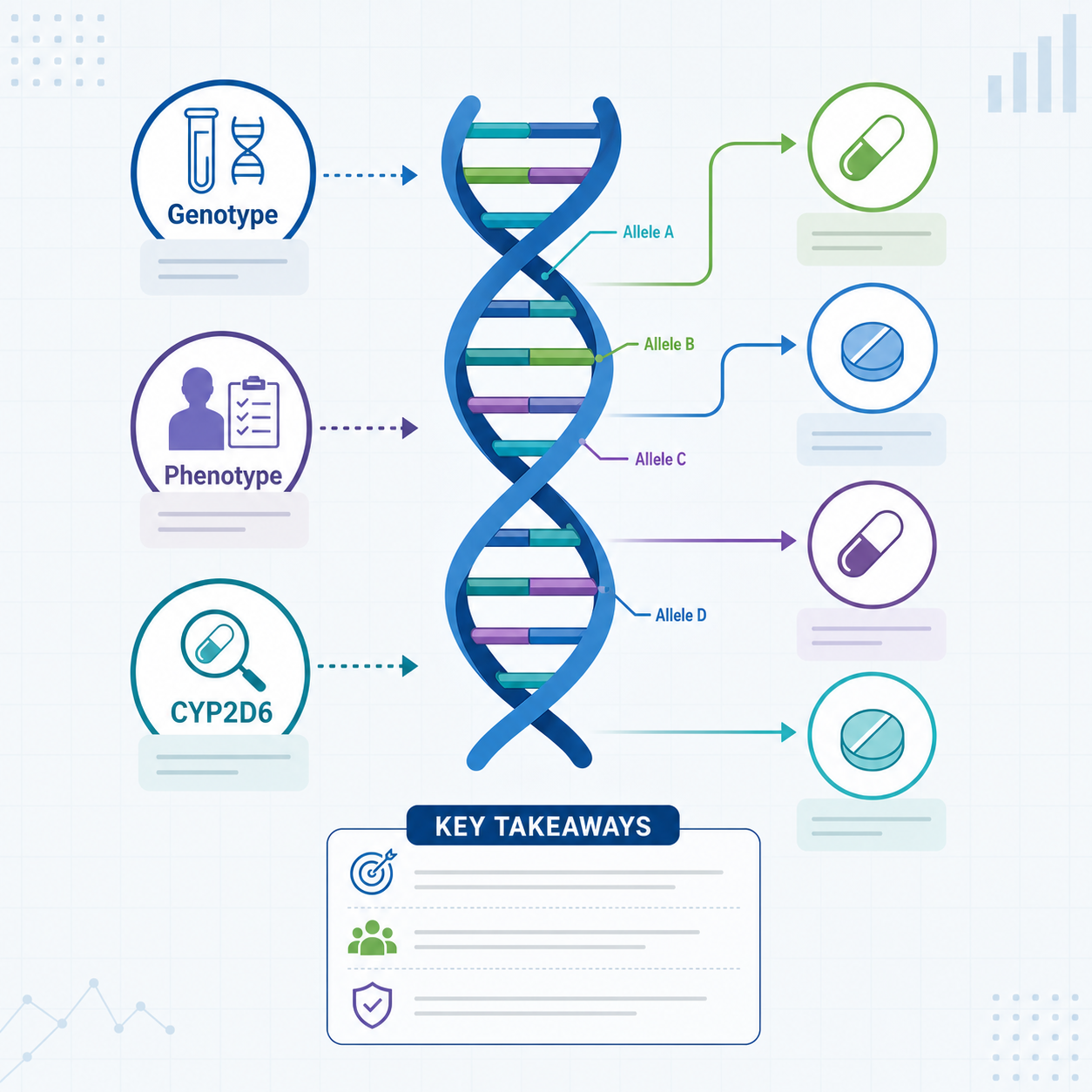
A pharmacogenetic DNA test can provide information about genes involved in drug metabolism, transport and pharmacological response. Laboratory results may be translated into a predicted metaboliser phenotype, such as normal, intermediate, poor or ultrarapid metabolisation, depending on the gene–drug pair and the testing method used.
This information is one part of the clinical picture. It should be considered alongside the medicine, the indication, other medicines, organ function, relevant medical history and the individual's response over time.
A predicted phenotype is not the same as measured enzyme activity at the time a medicine is prescribed. Co-medication, organ function, age and other factors can cause a person's functional metabolic state to differ from their genetically predicted phenotype — this is known as phenoconversion, and it is one reason a genetic result should be interpreted alongside the full clinical picture rather than in isolation.
Traditional prescribing often begins with a standard medicine and dose, followed by adjustment if the expected effect is not achieved or side effects occur. Pharmacogenetic information can provide additional context earlier in the decision process.
The objective is not to generate genetic data for its own sake. The objective is to translate relevant DNA information into a clinically appropriate decision, where the available evidence supports doing so.
Medicines are processed through interconnected biological pathways. Enzymes, receptors and transport proteins can influence how a medicine is activated, broken down, distributed or eliminated.
Many medicines are metabolised by enzymes in the liver. CYP2D6, for example, is involved in the metabolism of approximately 20–25% of commonly prescribed medicines. Other important genes include CYP1A2, CYP2B6, CYP2C9, CYP2C19, CYP3A4, CYP3A5, BCHE, DPYD, TPMT and VKORC1.
The relevant pathway varies from one medicine to another. Transport proteins such as SLCO1B1, as well as genes including HLA loci and IFNL3 (formerly known as IL28B), may also contribute to medication response.
Note on IFNL3/IL28B: this gene's main historical clinical use was predicting response to interferon-based hepatitis C treatment. Interferon-containing regimens have been largely superseded by direct-acting antivirals since the mid-2010s, so the clinical actionability of this marker is now limited for most patients being treated for hepatitis C today. It is included here for completeness of the panel, not as a marker with broad current clinical utility.
Amitriptyline or codeine, for example, may not be metabolised at the same rate by every individual. Differences in metabolism can influence the amount of active medicine or metabolite available in the body.
Medication response is also influenced by factors beyond inherited genetic variation. Drug–drug interactions, age, organ function, adherence and the underlying condition may all affect the clinical outcome. Allele frequencies for genes such as CYP2D6 also vary meaningfully across populations and ancestries, which can influence how common or expected a given result is.
DNA analysis can be used to create a personal pharmacogenetic profile. The profile described here provides an overview of potentially abnormal activity across more than 15 enzymes, transport proteins and receptors.
The profile can provide insight into biological pathways involved in medication processing. This may help clarify why a medicine could be metabolised differently from one individual to another.
The relevance of each result depends on the medicine being considered. A genetic finding may be clinically actionable for one gene–drug pair and have limited or uncertain significance for another. A test also cannot detect every possible relevant variant. Read more in the section "What are the limitations of pharmacogenetic testing?" below.
The profile can indicate whether an individual may have an abnormal response to more than 50 medicines. Only medicines for which an active dosing policy is currently recommended have been included in the profile described here.
A pharmacogenetic profile does not determine a medicine or dose on its own. It adds genetic context to the medication decision, while the appropriate prescribing approach remains dependent on clinical judgement and the individual's circumstances.
The clinical value of pharmacogenetic testing depends on how results are interpreted and integrated into care. A result becomes useful when it can support a specific medication decision and when the evidence for that gene–drug relationship is sufficiently robust.
Pharmacogenetic information may be considered when a medicine has a well-characterised gene–drug interaction, when an individual has experienced an unexpected response, or when a clinician is assessing medication choice or dose.
The timing and relevance of testing vary. Some recommendations concern pre-emptive testing, while others are intended to guide the use of results that are already available.
The Clinical Pharmacogenetics Implementation Consortium (CPIC) develops guidelines to help clinicians understand how available genetic test results can be used to optimise drug therapy. CPIC guidance is focused on the interpretation and use of results rather than making a universal recommendation about whether testing should be ordered.
The Dutch Pharmacogenetics Working Group (DPWG) provides evidence-based recommendations for specific gene–drug pairs. Its clinical implication framework distinguishes between testing that may be potentially beneficial, beneficial or essential, depending on the available evidence and expected clinical impact. (This tiering should be confirmed against the current DPWG framework, as terminology has been revised over time.)
There is not a single EU-wide body that plays an identical role to CPIC or DPWG. Instead, the European picture is built from several complementary sources:
These guidelines are not interchangeable with a general prescribing rule. Recommendations are specific to the gene, medicine, phenotype, clinical context and, in some cases, the healthcare system under consideration.
Pharmacogenetic results require clinical interpretation. A doctor or pharmacist can assess whether a finding is relevant to the medicine being considered, review other clinical factors and determine whether an adapted prescribing approach is appropriate.
This distinction matters. A genetic result can support a decision, but it does not replace the broader assessment required for safe and effective medication use.
Taken together, the evidence supports a specific and bounded clinical role for pharmacogenetic testing: for gene–drug pairs with well-characterised, guideline-supported associations (such as CYP2D6/CYP2C19 with selected antidepressants and opioids, DPYD with fluoropyrimidines, or SLCO1B1 with statins), a predicted phenotype can meaningfully inform medicine or dose selection alongside standard clinical assessment.
This is different from claiming that pharmacogenetic testing predicts an individual's response to any medicine, or that it should replace standard clinical monitoring. Its clinical value comes from being integrated into an existing prescribing decision by a qualified professional — not from being read as a standalone result.
Pharmacogenetic testing can provide clinically relevant information, but it does not explain every difference in medication response. The strength of the conclusion depends on the gene–drug pair, the quality of the evidence and the scope of the test.
No genetic test detects every possible variant. Targeted genotyping typically examines selected variants that have already been characterised. Rare variants, structural variants or variants outside the tested panel may not be identified.
For this reason, the specific variants included in the assay and the method used to translate genotype into predicted phenotype should be understood when results are interpreted.
No. A negative or unremarkable result means the tested variants were not identified within the scope and limits of the assay. It does not exclude untested variants, structural changes, non-genetic interactions, or a gene–drug relationship not included in the panel.
Genetic results may indicate an increased likelihood of a particular medication response. They do not guarantee efficacy, toxicity or a specific clinical outcome.
Claims should remain proportionate to evidence. The clinical question is not simply whether genetic variation is present, but whether the result is sufficiently relevant and actionable for the medicine and individual being considered.
Product context: BioAge DNA Health & Pharmacogenetics
The following section describes BioAgeDiagnostics' own product. It is provided separately from the general educational content above, which reflects publicly available scientific and clinical guidance rather than claims specific to this product.
Our DNA Health & Pharmacogenetics provides a pharmacogenetic profile covering genes involved in drug metabolism, transport and medication response, alongside broader health-related genetic information. The pharmacogenetic component of the profile can indicate potentially abnormal activity across more than 15 enzymes, transport proteins and receptors, and covers more than 50 medicines for which an active dosing policy is currently recommended.
For clinicians and clinics, Our Genetics & PGx for Clinicians provides a dashboard through which pharmacogenetic and broader genetic results can be reviewed, integrated into workflow, and shared with patients, including PGx dose-support information referenced against DPWG guidance.
The clinical objective of our DNA Health & Pharmacogenetics is to make relevant genetic information more actionable for healthcare professionals, while keeping conclusions proportionate to the available evidence. The profile does not determine a medicine or dose on its own, and does not replace the judgement of a doctor or pharmacist.
Pharmacogenetic testing analyses selected genetic variants that may influence how an individual responds to certain medicines. Results can provide information about drug metabolism, transport or pharmacological response.
Pharmacogenetics generally refers to the relationship between individual genetic variation and medication response. Pharmacogenomics is often used more broadly to describe the study of how the genome influences drug response. In clinical communication, the terms may overlap.
It may provide evidence about the likelihood of a particular response for a specific gene–drug pair. It cannot guarantee efficacy or predict every clinical outcome, and results must be interpreted alongside other patient and medication factors.
The pharmacogenetic profile described here can indicate whether an individual may have an abnormal response to more than 50 medicines. It also provides an overview of potentially abnormal activity across more than 15 enzymes, transport proteins and receptors.
No. The profile provides additional information for clinical decision-making. A doctor or pharmacist must interpret the results in the context of the medicine, the individual's clinical circumstances and the available evidence.
Phenoconversion is a difference between genetically predicted enzyme activity and an individual's actual, observed activity, caused by non-genetic factors such as enzyme inhibitors, inducers, organ function or age. It means a genetic result may not fully describe functional metabolism at the time of treatment.
Allele definitions are consistent across populations, but allele frequencies are not. For CYP2D6 and some other pharmacogenes, certain functionally important alleles are more common in some ancestries than others, which can affect how a result should be interpreted.
CPIC guidelines help clinicians use available genetic test results to optimise drug therapy. DPWG recommendations provide evidence-based guidance for specific gene–drug pairs and assess the potential clinical value of pre-emptive genotyping. Because no single EU-wide body plays an identical role, EMA product labelling, national competent authorities, and pan-European implementation research such as the U-PGx/PREPARE study also contribute to the European evidence picture. These sources should be applied within the relevant clinical context, and their frameworks are not interchangeable with each other or with a general prescribing rule.
Ordered per BioAgeDiagnostics SOP §2 (regulatory/governmental authorities → clinical guidelines → peer-reviewed literature → mechanistic/educational → commercial).
Links are provided from training knowledge and have not been live-verified in this session — confirm each before publication (SOP §18).
1. Regulatory and governmental scientific authorities
2. Scientific and clinical guidelines
3. Peer-reviewed scientific literature
4. Mechanistic and preclinical literature
5. Reputable scientific/medical educational sources
6. Commercial sources
This article is for educational purposes only and does not provide individual medical or prescribing advice. Pharmacogenetic results should be interpreted by an appropriately qualified healthcare professional in the context of the specific medicine, current prescribing guidance and relevant patient-specific factors. Medicines should not be started, stopped or changed on the basis of genetic test results without professional medical guidance.